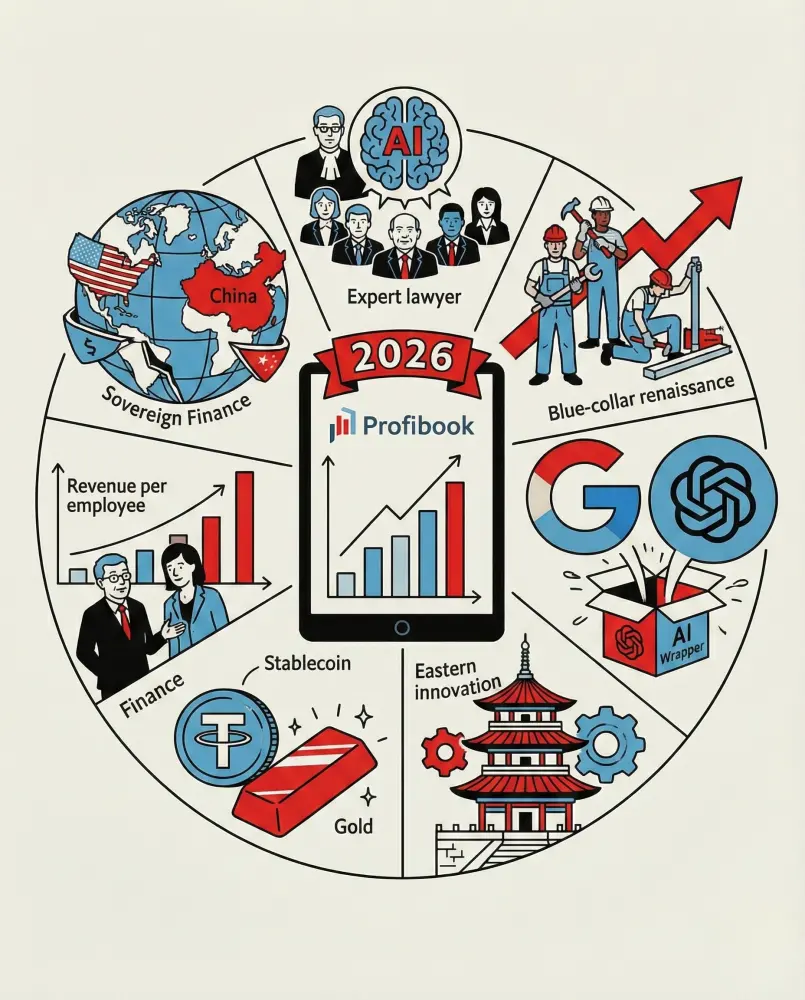
2026 will be the year the global economy is fundamentally re-indexed. For those of us leading tech companies, the window to adapt is no longer years. It is months.
Here is how I see the landscape shifting and how I am positioning Profibook to lead through it.
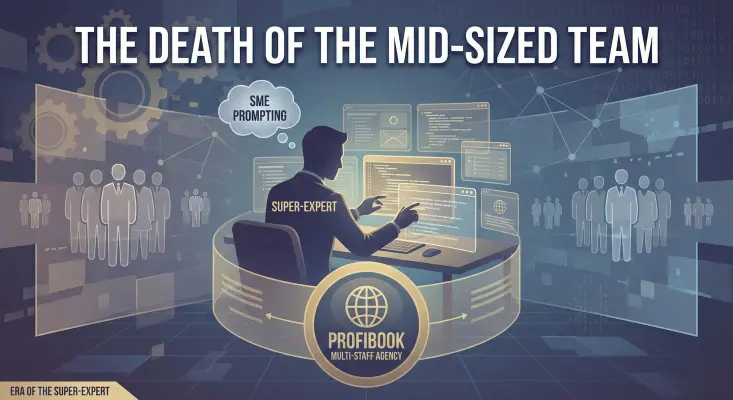
The death of the mid-sized team
The narrative that AI replaces jobs is too simplistic. The real shift is the collapse of team sizes. I believe we are entering the era of the Super-Expert.
One elite lawyer using agentic AI now does the work of ten. One software developer replaces a team of five. Success in this environment is dictated by Subject Matter Expertise (SME) prompting. This is the ability to direct AI with deep, industry-specific nuance.
Current data indicates that developers using AI-assisted tools achieve a 56% increase in task completion speed [1]. I am building Profibook for this reality. I want to enable a single professional to instantly scale into a multi-staff agency across various services and geographies.
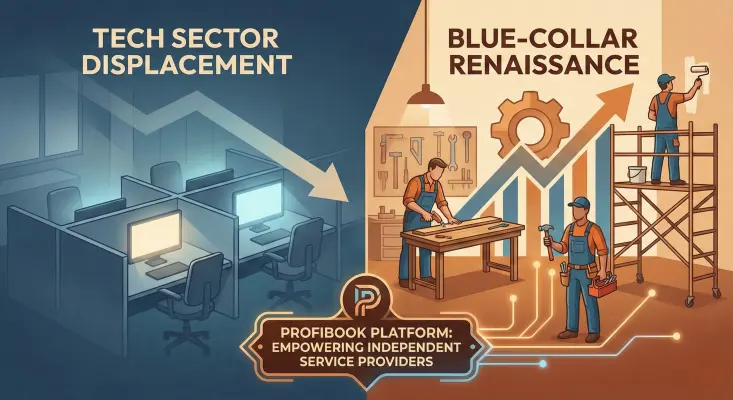
The Blue-Collar Renaissance
While white-collar sectors face displacement, I am observing a massive surge in demand for physical, hands-on skills. Painters, plumbers, and carpenters are becoming the most resilient workforce of the decade.
While the resulting layoffs in other sectors might cool the real estate market, the service-based economy remains the backbone of the US. Specialty trade employment is currently growing at a steady rate even as tech-heavy sectors contract [2].
This transition is a direct growth driver for the platform I am building. The pool of independent service providers is expanding and requires better tools to manage that growth.
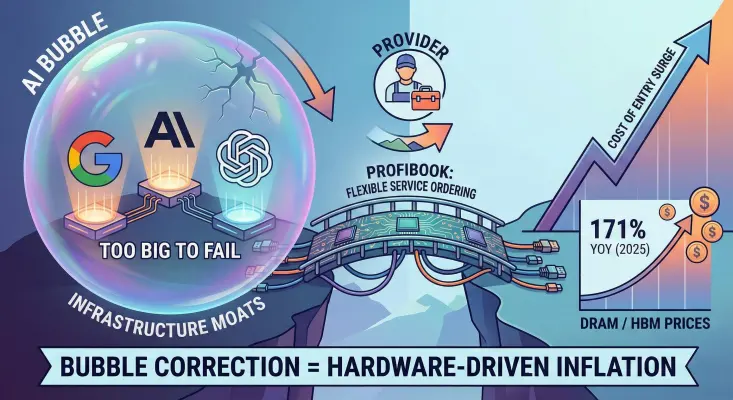
Bubble Economics and the Cost of Entry
While there is valid talk of an AI bubble, foundational companies like Google, Anthropic, and OpenAI are effectively "too big to fail" due to massive infrastructure moats. However, a bubble correction will have a specific sting: a surge in access costs.
AI is becoming a gated asset rather than a public good. Premium plans, token-based constraints, and government-reserved models are creating a deep societal divide.
Furthermore, the global dependency on American models creates significant latency and response failures during US peak hours. I believe the solution is not one "God-model" but AI orchestration.
Multiagent Systems (MAS) are projected to be the enterprise standard [3]. In this setup, small, specialized models are coordinated by a moderator AI. The future belongs to those who use limited-scope, cheap models rather than bloated, expensive ones.
The "hardware shortage" is no longer a temporary dip. By late 2025, DRAM and high-bandwidth memory prices rose by a staggering 171% year-over-year [3]. This hardware-driven inflation means the "monopoly premium" for frontier AI will only go up. At Profibook, I am building flexibility into our service ordering so providers can pivot as these operational costs fluctuate.
The End of the "AI Wrapper"
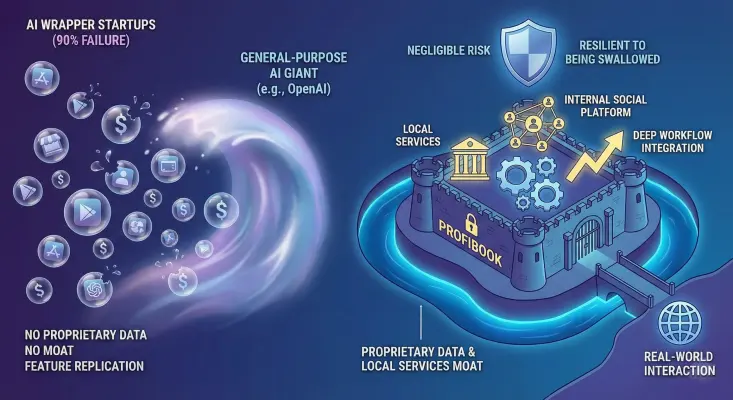
Many startups acting as mere "AI wrappers" are already losing ground. If there is no proprietary data or unique physical-world interaction, giants like OpenAI will simply replicate the feature as they expand into vertical markets [4]. Recent market analysis shows a brutal 90% failure rate for AI startups that lack a distinct moat [5].
I have positioned Profibook in the local services sector, a space where we own proprietary data and host an internal social media platform. By focusing on deep workflow integration and unique data that we do not sell to third parties, the risk of being "swallowed" by a general-purpose AI is negligible.
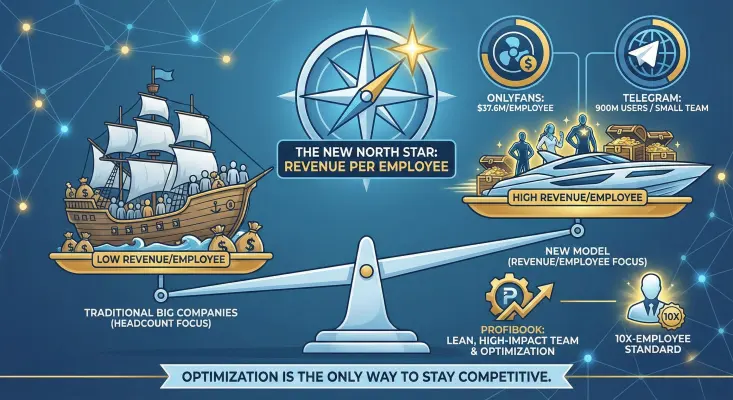
Revenue per Employee: The New North Star
Big companies are getting smaller. The trend is moving away from headcount toward revenue per employee. I look at role models like OnlyFans, which generates $37.6 million in revenue per employee, or Telegram, which serves 900 million users with a stripped-down workforce [6], [7].
While I am focused on growth, my priority is building a lean, high-impact team where every role is crucial and processes are surgically defined. Optimization is the only way to stay competitive when the 10x-employee becomes the standard.
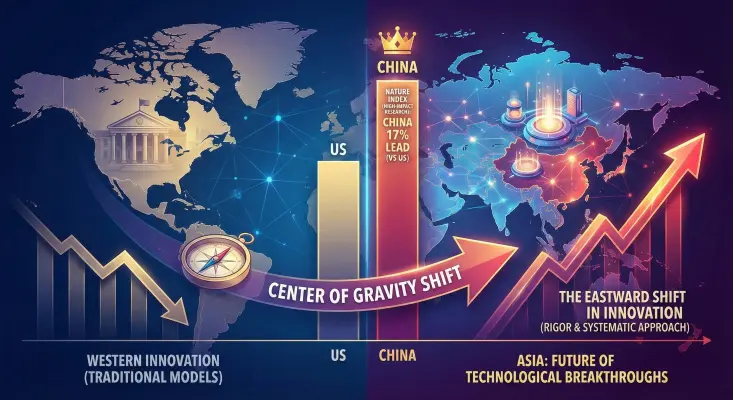
The Eastward shift in Innovation
The center of gravity for human capital has moved. While Western educational models were once the benchmark, the Chinese approach to rigor and systematic upbringing now leads the world. This is reflected in the Nature Index, where China has officially overtaken the US in high-impact scientific research output by a margin of 17% [8]. I expect a significant portion of technological breakthroughs to originate from Asia in the coming years.
Sovereign Finance and the Gold Hedge
In finance, stablecoins have become the de-facto standard for cross-border transfers. Monthly stablecoin volume has reached $1.25 trillion, rivaling 50% of the volume handled by legacy payment giants like Visa [9]. My roadmap for Profibook includes full freedom of payment choice, specifically crypto.
Simultaneously, the world is hedging against fiat instability. Led by China, which has led central banks in record gold purchases exceeding 1,000 tonnes annually, I am watching a return to money backed by gold reserves [10].

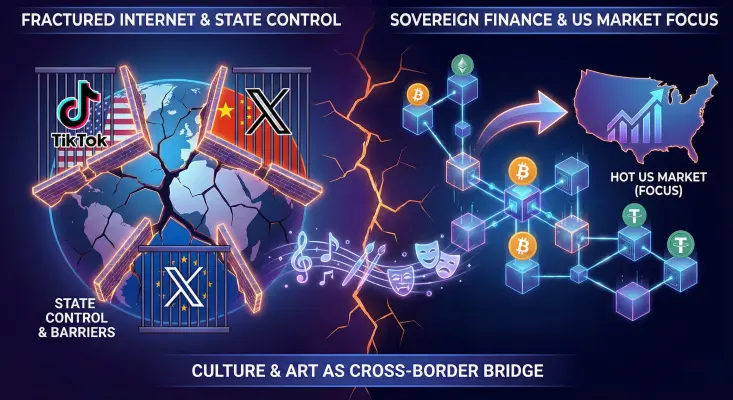
A fractured internet and Sovereign Finance
Geopolitical tensions are killing the "Borderless Web." State control over platforms like TikTok and X is the new reality. In this fractured environment, I see culture and art as the primary vehicles for cross-border exchange and de-escalation.
While I lead a globally distributed team, my focus remains the US market. It is one of the few truly hot markets left, especially as emerging economies in Africa and Central Asia struggle with systemic corruption.
The Bottom Line
The global shifts we see today, from the rise of the Super-Expert to the resurgence of the physical trades, all point to one unavoidable truth: the future of work is decentralized, lean, and highly specialized. We are moving away from bloated corporate structures and toward a high-efficiency service economy powered by sovereign finance and orchestrated AI.
I am not just building a platform to observe these changes; I am building the infrastructure that makes them actionable. Profibook is designed to be the operating system for this new era, turning the volatility of 2026 into a scalable advantage for the professionals who drive our economy.
Sources:
[1] Penn Wharton Budget Model, "Impact of Generative AI on Productivity and Task Speed," 2025.
[2] U.S. Bureau of Labor Statistics, "Employment Situation Summary: Specialty Trade Contractors," Nov. 2025.
[3] Techoutlet, "AI Hardware Crisis 2026: The Hidden Cost Wave," Dec. 2025.
[4] Canvas Business Model, "Growth Strategies and Future Prospects of OpenAI," 2025.
[5] MktClarity, "The AI Wrapper Market: Failure Rates and Vertical Defense," Nov. 2025.
[6] Business Standard, "OnlyFans tops Apple, Meta, Nvidia with $37.6 mn revenue per employee," Oct. 2025.
[7] Business of Apps, "Telegram Revenue and Usage Statistics," 2025.
[8] Nature Index, "Research Leaders 2024/2025: Global Scientific Output Analysis," 2025.
[9] Galaxy Research, "The State of Stablecoins vs. Legacy Rails," Dec. 2025.
[10] World Gold Council, "Central Bank Gold Reserves and Geopolitical Hedging Trends," Oct. 2025.